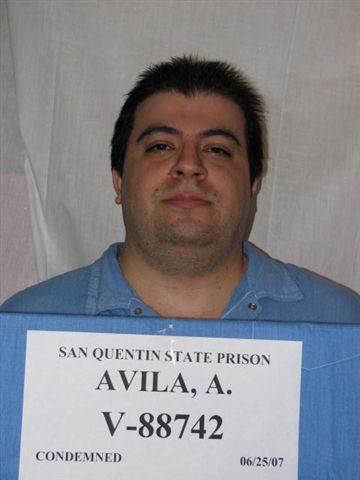
I. The individual
| Name on the Governor's list | Avila, Alejandro1 |
|---|---|
| Name on CDCR roster | AVILA, ALEJANDRO2 |
| CDCR number | V88742 |
| Age | 51 (as of Nov. 3, 2026)2 |
| Age at offense | 272 |
| Received by CDCR | July 25, 20052 |
II. The convictions
The California Supreme Court's opinion on the automatic appeal opens with the following account of the convictions and sentence. It is quoted verbatim. Where the Court later reversed any part of the judgment, that appears in section VII.
A jury convicted defendant of kidnapping, committing two counts of lewd and lascivious acts on, and then murdering Samantha Runnion under the special circumstances of murder while kidnapping and murder while committing lewd and lascivious acts on a child under the age of 14. (Pen. Code, §§ 187, 190.2, subd. (a)(17)(B) & (E), 207, 288, subd. (b).) After a penalty trial, the jury returned a verdict of death. The court denied the automatic motion to modify the verdict (§ 190.4) and imposed that sentence. This appeal is automatic. (§ 1239, subd. (b).) We affirm the judgment. I. The Facts A. Guilt Phase 1. Prosecution Evidence a. The Crime Around 6:30 p.m. on July 15, 2002, five-year-old Samantha Runnion and her six-year-old friend, Sarah A., were playing outside of the Smoketree condominium complex in Stanton. Sarah observed a man driving a green car pass by them, go around the block, and approach them a second time. The man got out of the car and asked the girls, “Have you seen a little puppy?” Samantha asked about its size. Suddenly, the man grabbed Samantha, threw her, screaming and struggling, into the car, and sped away. Samantha’s nude body was found the next day in a remote area near Lake Elsinore, near the intersection of the Killen Truck Trail and Ortega Highway, that is popular with hang gliders. An autopsy performed the next morning revealed that Samantha had been sexually assaulted both vaginally and anally. She had suffered at least two blows to the head at least half an hour before she died, which caused her brain to swell.
III. The case history
- July 15, 2002Offense date recorded by CDCR.2
- July 22, 2005Judgment of death, Orange County Superior Court (case 02CF1862).1
- July 25, 2005Received by CDCR.2
- June 30, 2014California Supreme Court decides People v. Avila, 59 Cal. 4th 496: judgment affirmed.3
- Nov. 5, 2026Governor names this person on the List of Intended Clemency Recipients.1
- Nov. 15, 2026Petition filed asking the Supreme Court to stay all proposed commutations.4
| Trial case no. | Charging county | Trial county | Death judgment |
|---|---|---|---|
| 02CF1862 | Orange | Orange | July 22, 20051 |
IV. The victims
No victim has yet been entered for this case from a verified source. The court's account quoted above may name them. We only list a victim's name when a court record or an established news organization reports it.
No published statement from a victim's family has been recorded for this case.
V. The original sentence
Death. Judgment of death entered July 22, 2005 in Orange County Superior Court, case 02CF1862.1
CDCR records a sentencing date of July 22, 2005.2
Current sentence: Death. California has carried out no execution since 2006, and executions have been under a governor's moratorium since 2019.5 A commutation would change the sentence to life imprisonment without the possibility of parole. That change has not been made.
VI. The executive decision
Status as of Sunday, November 29, 2026
Proposed; not yet issued. The Governor lists this person as having only one felony conviction, so no Supreme Court recommendation is required. The Governor's office says the commutations "will not go into effect until the necessary legal steps are completed."6
| Date | Action |
|---|---|
| Nov. 5, 2026 | Named on the Governor's "List of Intended Clemency Recipients." Proposed commutation: death to life imprisonment without the possibility of parole.1 |
| Nov. 15, 2026 | Named as a real party in interest ("548 Persons Sentenced to Death") in a petition for writ of mandate asking the California Supreme Court to stay all of the proposed commutations.4 |
The Governor's stated reasons
No reason specific to this case has been given. The same commutation was proposed for all 548 people. The Governor's explanatory statement to the Supreme Court says:
"The Governor did not consider information about their individual circumstances, apart from the facts that a death sentence was imposed in their cases and they have more than one felony conviction."
His general reasoning: Open letter · Explanatory statement · Letter to the Supreme Court
VII. Appeals and judicial findings
People v. Avila (2014) 59 Cal. 4th 496
Supreme Court of California · No. S135855 · decided June 30, 2014 · Disposition as stated in the opinion: Judgment affirmed3
Opinions matched by name and date from Harvard's Caselaw Access Project, which covers California Supreme Court opinions through 2016. Later decisions, habeas proceedings and federal rulings are not yet in this file.
VIII. Source documents
- GovernorList of Intended Clemency Recipients. Office of the Governor of California, Nov. 5, 2026. Retrieved Nov. 29, 2026.
- CDCRCondemned Inmate List (updated November 3, 2026; total 561). California Department of Corrections and Rehabilitation, Nov. 3, 2026. Retrieved Nov. 29, 2026.
- Court opinionPeople v. Avila (2014) 59 Cal. 4th 496. Supreme Court of California (text via Harvard Caselaw Access Project), June 30, 2014. Retrieved Nov. 28, 2026.
- Court filingFriend et al. v. Newsom — Petition for Writ of Mandate (stay requested). California District Attorneys Association / Criminal Justice Legal Foundation, Nov. 15, 2026. Retrieved Nov. 29, 2026.
- GovernorFact Sheet: California Commutations. Office of the Governor of California, Nov. 5, 2026. Retrieved Nov. 29, 2026.
- GovernorClemency. Office of the Governor of California. Retrieved Nov. 29, 2026.
- GovernorExplanatory Statement – Proposed Death Penalty Clemency Action. Office of the Governor of California, Nov. 5, 2026. Retrieved Nov. 29, 2026.
Last verified Nov. 29, 2026 · Research level: rosters + California Supreme Court opinion · Report an error